
Polished concrete flooring in Wisconsin is a core service of Duraguard Protective Coating Solutions. We grind, densify, and polish existing and new concrete slabs into hard, reflective, long-lasting floors for warehouses, manufacturing plants, food processing facilities, retail spaces, and commercial buildings throughout Wisconsin and Northern Illinois.
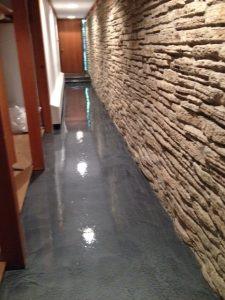
Wisconsin’s freeze-thaw cycles and winter de-icing salt exposure are tough on coated floors — topical films can chip, peel, or delaminate over time. Polished concrete removes that failure mode entirely, because the finished floor is the slab itself, hardened from the inside out and polished to the sheen level you specify.
Request a free site evaluation to assess your slab and discuss finish options.
Call Duraguard at (262) 770-2218 to schedule.
What Is Polished Concrete Flooring?
Polished concrete is a mechanically ground, densified, and polished floor system — not a coating. We refine the slab itself through a series of progressively finer diamond abrasives, chemically harden it with a lithium or sodium silicate densifier, and finish it to the desired gloss.
Because there is no film layer on top, there is nothing to peel, chip, or delaminate. The surface is the concrete, made denser and more reflective.
The Mechanical Polishing Process
We start with coarse metal-bond diamond tooling to strip existing coatings, open the surface, and level high spots. From there we step through progressively finer resin-bond diamonds — commonly 100, 200, 400, and 800+ grit — each pass removing the scratch pattern left by the previous stage.
A densifier is applied between stages to react chemically within the slab, filling pore structure and increasing surface hardness. A final penetrating guard is burnished in to resist staining.
The process can be performed on new pours after cure, or on existing slabs during a facility upgrade.
Aggregate Exposure Levels
The depth of the initial grind determines what the finished floor looks like.
- Cream finish: Grinding stops at the surface paste. Minimal sand or stone is visible — a uniform, smooth appearance well suited to offices, showrooms, and corporate lobbies.
- Salt & pepper: A deeper grind exposes small sand aggregate flecks. This is a common choice for warehouses and industrial floors because the subtle texture hides wear patterns.
- Full aggregate exposure: The deepest cut reveals the larger stone aggregate in the slab, producing a terrazzo-like look used in retail, hospitality, and feature spaces.
Not sure which exposure fits your facility? We’ll walk the space with you during a free site evaluation.
Benefits of Polished Concrete for Wisconsin Facilities
Durability and Longevity
Polished concrete withstands years of forklift traffic, pallet jacks, heavy loads, and foot traffic without wearing through a film — because there is no film. The slab itself is hardened and refined.
It resists abrasion, impact, and the chemical exposure common in manufacturing and food processing environments.
Low Maintenance and Lifecycle Cost Savings
There is no wax to apply, no stripper to buy, and no recoat cycle to schedule. Routine cleaning with an auto-scrubber and a neutral cleaner keeps the floor performing and looking its best.
High light reflectivity amplifies overhead and natural light, which can meaningfully reduce lighting costs in large warehouses and distribution centers. Over a decade, the absence of recoating labor and consumables adds up — a key reason facility managers and CFOs favor polished concrete over coated systems.
Hygienic and Cleanable Surface
Once densified and guarded, the surface is seamless and non-porous. It resists moisture penetration, bacterial growth, and staining — important in food processing, brewing, and other regulated environments. It also stands up to washdowns and temperature swings.
Slip Resistance and Safety
Polished concrete provides a controlled level of slip resistance, and anti-slip measures can be incorporated where wet conditions are routine. There are no edge-lifting coatings or tile seams to create trip hazards.
Densifiers and Guards: The Chemistry Behind the Hardness
Densification is what separates polished concrete from a simple grind-and-seal. A silicate densifier reacts with free lime (calcium hydroxide) inside the concrete to form calcium silicate hydrate, which fills the pore structure and hardens the slab from within.
This is a chemical reaction, not a coating. The hardness lives inside the floor.
Lithium and Sodium Silicate Densifiers
Lithium silicate densifiers react quickly, often allowing a prompt return to grinding, and are low-VOC — a good fit for occupied buildings and food-service environments. Sodium silicate densifiers penetrate deeply and are a strong fit for both new pours and older slabs.
On many Wisconsin projects we use our own Durahard densifier as part of the polishing sequence.
Topical Guards and Stain Resistance
After polishing, a penetrating stain guard — such as our Duraseal — is applied and burnished into the surface to protect against oil, grease, and chemical soiling. A guard does not create a film layer; it fills microscopic pores so the floor resists staining while keeping the polished appearance and breathability of the slab.
CSDA Gloss Levels and Finish Specifications
Polished concrete gloss is measured against a four-level industry classification. Specifying the level up front keeps expectations clear between owner, designer, and installer.
- Level 1 — Ground (Flat): Matte finish, minimal reflectivity. Typically achieved around a resin-bond stage in the lower grits.
- Level 2 — Honed (Satin): Low sheen with subtle reflection. A durable, low-glare finish for industrial and warehouse environments.
- Level 3 — Semi-Polished: Noticeable shine and moderate reflection. A balanced look for mixed-use commercial spaces.
- Level 4 — Highly Polished: High-gloss, mirror-like reflection. Common in showrooms, retail, lobbies, and office environments where appearance is a priority.
As a general guide, Level 2–3 fits most industrial and warehouse floors — the finish hides wear and reduces glare. Level 3–4 is a better fit for retail, showroom, and office spaces where the floor is part of the design.
Call us at (262) 770-2218 to discuss the right gloss level for your space.
Polished Concrete Applications in Wisconsin
Duraguard installs polished concrete systems across a wide range of facilities throughout Southeast Wisconsin and Northern Illinois.
Warehouses and Distribution Centers
High-traffic, heavy-load environments where durability and low maintenance drive the decision. A salt-and-pepper or cream finish at Level 2–3 hides forklift wear and keeps the facility looking clean.
Manufacturing and Industrial Plants
Floors in production environments face chemical spills, abrasion, and heavy equipment. Polished concrete with a silicate densifier and stain guard performs well under those conditions, and the seamless surface eliminates dust generation and simplifies cleaning. For spaces that need electrostatic control, we also install ESD conductive floor coating in Wisconsin as a specialty system.
Food Processing and Brewery Facilities
Where washdowns, moisture, and temperature swings are the norm, some facilities need the chemical and thermal resistance of a urethane concrete topping instead of — or in addition to — polished concrete. See our Duraclad 903 urethane concrete flooring for those environments, or our commercial kitchen epoxy flooring for back-of-house and prep areas.
Retail, Showroom, and Office Spaces
Full aggregate exposure or a high-gloss cream finish turns the floor into a design element. Light reflectivity enhances the space and reduces lighting load.
Project Examples
Near North Montessori School — Chicago, IL (June 2019): 15,000 sq ft of polished concrete, polished to 1500 grit, using Durahard densifier and Duraseal across the lobby, stairs, seating area, and cafeteria.
Chicago Cubs headquarters, Wrigley Field — Chicago, IL: 5,000 sq ft of polished concrete with an exposed-aggregate finish across lobby and office areas.
For more finished-floor images, visit our polished concrete flooring gallery.
The Duraguard Polishing Process
Step 1 — Slab assessment and preparation. We assess the existing slab, address cracks and joint damage, and determine the starting grit based on slab condition and desired aggregate exposure.
Step 2 — Coarse grinding and aggregate exposure. Metal-bond diamond tooling strips old coatings, levels high spots, and opens the surface. If salt-and-pepper or full exposure is specified, we grind to the depth required to reveal the aggregate.
Step 3 — Densification. We apply our Durahard densifier, keep it active for the required dwell, and work it into the slab. Any unreacted residue is removed to prevent hazing.
Step 4 — Progressive polishing. Resin-bond diamonds step through finer grits — 100, 200, 400, and 800+ as the specification requires — each pass refining the surface. The final grit, together with burnishing, determines the gloss level.
Step 5 — Guard application and burnishing. We apply Duraseal and burnish the floor to the specified finish, then walk the project to inspect for defects, hazing, or uneven sheen.
Polished Concrete vs. Coated Floors
- No delamination risk. The floor is the slab, not a film that can peel or separate.
- No recoat cycle. Coated systems typically require periodic reapplication; a properly densified and guarded polished floor does not.
- Lower lifecycle cost. No wax, no stripper, no recoat labor — just routine cleaning.
For spaces that mix polished and coated areas, see our related polished concrete flooring industrial commercial Wisconsin, our [stained concrete flooring Wisconsin](https://www.duraguardsolutions.com/duraguard-floor-coating-gallery-wisconsin/stained-concrete-flooring-wisconsin/), and our concrete floor grinding and sealing services.